Emerald Display in Cabinets and Museums
Emerald display reveals how cabinets and museum cases frame a jewel; learn to read its setting, neighbours, label and lighting during a gallery visit.
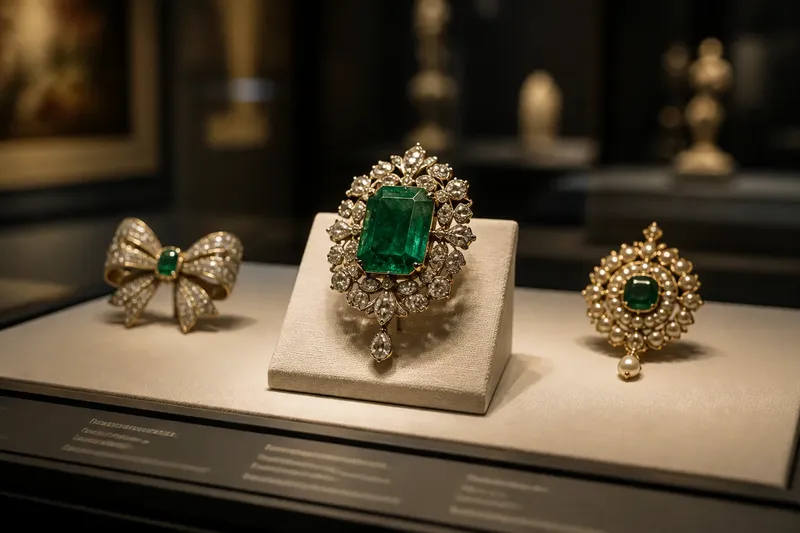
At a museum case, an emerald may sit alone on a pale mount while neighbouring jewels are arranged in a row. Emerald display is not only about the stone: the case, label and objects around it shape what a visitor can see and infer.
There is no single history in which private cabinets simply gave way to public galleries. Collectors, institutions and exhibitions have arranged jewels in different ways, and access has varied with place and purpose. Looking closely at one display offers a more reliable account than assuming a universal progression.
What did a private cabinet make visible?
A cabinet could bring small, valued objects together in drawers, shelves or compartments. Its contents might include jewels alongside miniatures, shells or other collected objects. A host decided what to bring out and how to present it, so a visitor’s view depended on invitation and selection.
An emerald in a cabinet need not have been treated as a masterpiece on its own. It could be one object among many, valued for comparison or as part of a collection. The arrangement made ownership and choice visible: someone had gathered the objects, placed them and controlled access to them.
Not every cabinet had the same purpose or audience. It is safer to read a particular cabinet through its documented contents and setting than to infer a standard ritual of viewing from the furniture alone.
What changes when an emerald is shown in a gallery?
A museum case allows visitors to look without handling the object, while a label can identify material, maker, owner or use when that information is documented. The case also sets limits: glass, mounts and the visitor’s permitted route shape where a person can stand and what they can see.
Grouping matters. An emerald ornament placed beside related jewellery may invite comparison; displayed alone, it may receive more visual attention. Neither arrangement explains itself. The label and the wider exhibition context may clarify the institution’s intention, but a visitor should distinguish that information from personal interpretation.
For a specific historical claim, look for a named collection, place, date or exhibition record. Without such evidence, describe what the display does rather than claiming that all galleries, or all earlier cabinets, worked in the same way.
How do case design and lighting guide the eye?
A mount can turn an object towards the visitor or raise it above the case floor. A dark or pale backing changes its visual contrast, while nearby objects may either compete for attention or provide a point of comparison. Reflections on glass can interrupt the view, and a change of position may help if the gallery layout permits it.
Lighting involves competing needs. A bright area may make a detail easier to notice, yet glare can obscure part of the object. Museums also consider conservation when deciding how objects are displayed, so a visitor should not treat one lighting arrangement as a complete account of how an emerald looks elsewhere.
Say you enter a gallery and see an emerald brooch on a raised mount beside two other ornaments. You first notice its outline; then, by reading the label, you learn whether the display identifies a shared period or use. If the label gives no such link, the visible grouping remains an observation, not proof that the objects have a documented connection.
How can you read an emerald display during a visit?
A few focused observations are enough; there is no need to make a circuit of every case or return repeatedly to one object. Start with the display as it stands, then use the label to separate documented information from your own reading.
- Check the emerald’s position. If it is set apart, note that the display gives it visual space; if it is grouped with other objects, compare their forms before inferring a relationship.
- Check the mount’s direction. If one face is turned towards the visitor, describe that orientation; if the object faces away or lies flat, avoid assuming the unseen side is unimportant.
- Check the nearest objects. If they share a visible feature, such as being jewellery, note the similarity; if they differ, treat the grouping as a curatorial choice rather than a proven historical link.
- Check the view through the glass. If reflections block a detail, shift position only where the gallery allows; if the view remains obstructed, leave that detail unresolved.
- Check the label for named facts. If it identifies an owner, date or use, distinguish that information from your impression; if it does not, do not fill the gap with a guess.
- Check the space around the object. If the mount stands alone, note the separation; if space is shared with other pieces, observe how close they are without assigning a motive to the layout.
It is not worth trying to decode every reflection or treating an empty patch of case as a hidden message. A precise observation, kept separate from an assumption, is more useful than an elaborate story unsupported by the display.
What questions help explain an emerald display?
Why might a museum show an emerald alone?
An isolated mount gives the object more visual space and may direct attention to its form or documented history. The arrangement alone does not reveal why the curator chose it.
Why are emeralds displayed beside other objects?
A group can invite comparison or contribute to a theme such as jewellery or collecting. A label or exhibition text may explain the intended connection; without one, describe the grouping without claiming a shared history.
Does bright lighting show an emerald more faithfully?
Bright light may help reveal some details, while glare or reflections can obscure others. The display presents the object under particular conditions, not every way it may appear.
What can an empty space in a case mean?
It may give an object room, separate groups or simply reflect the case layout. Unless a label or other documented source explains it, the space is best recorded as an observable feature rather than assigned a historical meaning.
What can a cabinet still tell us?
A cabinet remains a useful way to think about selection and access, but it should not stand in for every past collection. A particular emerald’s display is better understood through its documented setting, the objects beside it and the choices visible in the case.
Before leaving, note one feature you can describe plainly: the emerald’s position, its neighbours, the mount’s angle or a reflection across the glass. That small record keeps the history of display grounded in what was actually presented, while leaving unsupported explanations aside.