Why Emerald Green Changes from One Angle to the Next
Why emerald green changes with light and viewing angle, plus a calm way to observe its shifting tones without mistaking appearance for a quality verdict.
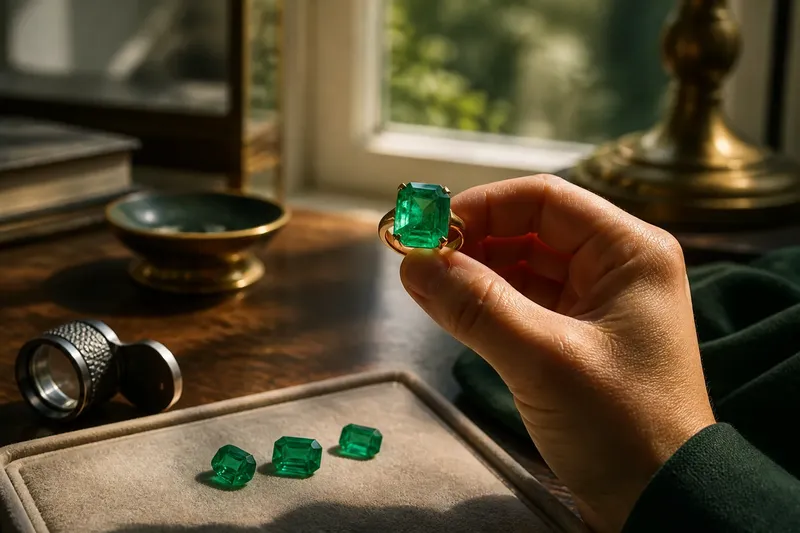
At a window, an emerald may look deep green; turn it slightly towards the room and a brighter patch can appear near its centre. Why emerald green changes from one angle to the next is not a puzzle with one cause: light, the stone’s internal features and the direction of your gaze all take part.
These compact field notes offer a way to notice those shifts without turning a momentary impression into a judgement about quality. The useful question is not simply “Is it green?” but “What changed when I moved?”
What changes when you turn the stone?
A faceted emerald sends light back towards the eye along different paths as it moves. A small turn can bring one facet into a bright reflection while another falls into shadow, making neighbouring areas seem lighter, darker or subtly different in hue.
The stone has not changed; the light reaching your eye has. This is especially easy to notice when a bright window or lamp is reflected in one part of the surface. Watch whether the bright area travels across the facets, rather than treating it as a permanent feature of the colour.
Viewing direction matters too. Look down towards the table, the broad upper face, then shift your head a little to either side. The colour may seem more even from one position and more broken up from another. A single straight-on glance records only one arrangement of light and shadow.
How does the light source alter green?
Daylight near a window and warm household lighting do not have the same colour character. Under a warm lamp, an emerald can seem yellower or softer; beside a window, its green may appear cooler or more distinct. Neither view is automatically the stone’s definitive appearance.
For a calm comparison, begin in diffuse daylight rather than direct sun. Then look under one ordinary indoor light, keeping the background and viewing position as similar as you can. Let your eyes settle before comparing. Rapidly carrying the stone between very different surroundings makes it harder to tell which change came from the light and which from your own adjustment to it.
Reflections from the setting and nearby surfaces can colour the impression as well. A gold-coloured mount, a dark sleeve or a brightly coloured table may be reflected in the stone. If a tint seems to appear only when the emerald faces one particular surface, that reflection may be part of what you are seeing.
What can the interior reveal to the eye?
Emeralds commonly contain internal features, including fine lines, small crystals and cloudy areas. These are often called inclusions. As light crosses them, it can scatter, soften or interrupt the green, so one region may look clearer while another seems mistier or more muted.
Some features are easiest to see when the stone is angled towards a light source; others stand out against a darker background. A bright reflection can briefly conceal detail, while a slight turn may make it visible again. Try to separate the appearance of the colour from the visibility of an internal feature: the two can affect one another, but they are not the same observation.
There is little value in chasing every tiny mark with strong magnification if your aim is to understand the colour. A loupe can reveal detail, but it also narrows the view and can make ordinary internal features seem more decisive than they are. Begin with the unaided eye and use magnification only to answer a particular question.
How can you observe the changes without grading them?
Choose a quiet spot with steady, indirect light and hold the stone securely over a plain, neutral background. Move it gently through a small range of angles, pausing at each position rather than spinning it. Notice the broad pattern: where the green looks deeper, where it brightens, and whether those areas move with the reflection.
Say you are looking at an emerald in a simple ring near a window. You first see a dark green centre, then tilt your hand slightly and notice a pale streak slide towards one edge. If the streak shifts as the ring turns, you can record it as a moving light reflection; you do not need to treat that brief view as a verdict on the stone.
If you want to keep a record, use plain words such as “darker at the centre by the window” or “more even under the room lamp”. Avoid assigning a score to each position. The notes are most useful when they preserve the conditions of the observation, not when they pretend to rank the emerald.
What questions help make sense of a shifting emerald?
Why does an emerald look darker when I tilt it?
The new angle may send less reflected light towards your eye, or place more facets in shadow. Turn it back slowly and see whether the darker area follows the movement.
Does a brighter patch mean the colour is better?
Not by itself. A bright patch may be a reflection or a facet catching light, and it can disappear with a small change in position.
Should I compare emeralds under a shop spotlight?
A spotlight can make surface reflections conspicuous and leave other areas comparatively dark. If comparison matters, also look in steadier, diffuse light and note the different conditions.
Can a photograph show the same colour shifts?
A photograph freezes one angle and one lighting arrangement, while a screen can alter the appearance further. Treat it as a record of a particular view, not a substitute for watching the stone move.
When is a colour impression not enough?
Seeing a change is useful, but it does not establish what caused it in every case or determine the stone’s overall quality. Colour is only one part of how an emerald is assessed; internal features, cutting and other details also matter. If you are making a purchase or need a formal opinion, ask a qualified gemmologist or reputable jeweller to assess the stone in person.
For your own observations, keep the method modest: name the light, note the angle and describe what visibly moves or stays put. That simple record makes “emerald green changes from one angle to the next” a specific observation rather than a verdict disguised as one.