The Green-Stone Shortcut: Why Colour Alone Cannot Identify an Emerald
Colour alone cannot identify an emerald. Learn how material, inclusions, treatment and expert examination help establish what a green stone actually is.
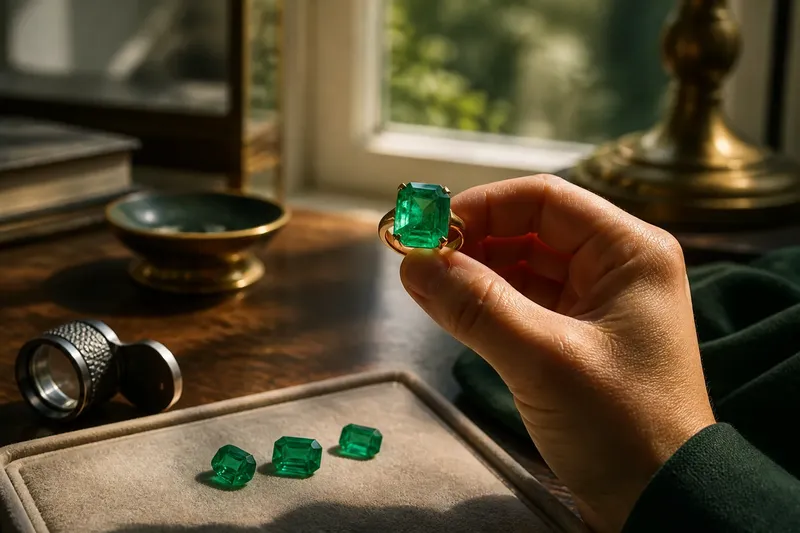
A green stone catches the light in a jeweller’s window, and the word “emerald” comes readily to mind. But colour alone cannot identify an emerald: several materials share that colour, while genuine emeralds vary in shade and appearance. Green is a useful first observation, not a verdict.
Why does green feel like proof?
Colour is the feature we notice first, yet it can be altered in appearance by lighting, surrounding colours, a stone’s cut and what lies behind it. A green appearance prompts a reasonable question, but it cannot establish what mineral the object is.
In gemmology, emerald is a variety of the mineral beryl coloured chiefly by trace elements such as chromium and, in some stones, vanadium. That description refers to composition and crystal structure, not simply to a shade on a colour chart. A green stone made from another mineral or material may resemble an emerald without being one.
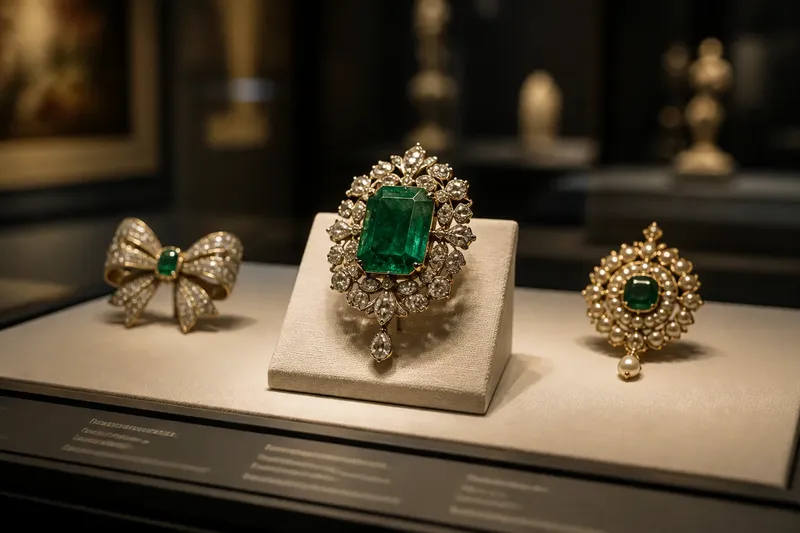
This distinction matters because names carry expectations. A seller’s description, an inherited label or a price tag may use “emerald” loosely, as a colour term or appealing shorthand. For a purchase, insurance document or catalogue entry, the relevant question is whether the stone’s identity has been established and what evidence supports that claim.
What else can look like an emerald?
Green tourmaline, green garnet, peridot, green sapphire and glass can all produce appearances a casual viewer might associate with emerald. Some are natural gemstones, while glass is a manufactured material. Their colours overlap, but their identities and physical properties differ.
There are also synthetic emeralds: laboratory-grown material with the same essential chemical composition and crystal structure as natural emerald. “Synthetic” does not mean imitation in the sense of glass pretending to be beryl; it identifies a different origin. An imitation, by contrast, is a different material used to resemble the stone, and a simulant is a lookalike that may be natural or manufactured.
These terms answer separate questions. “Natural” describes origin; “synthetic” describes laboratory growth; “imitation” or “simulant” describes a material’s role as a substitute. A stone can be green, attractive and accurately described as a simulant without being an emerald.
Which clues help, and what can they not tell you?
Visible clues can make one possibility more plausible than another, but they rarely settle identity by themselves. Inclusions—features within a stone—are particularly tempting to interpret. Emeralds commonly contain internal features, sometimes called jardin, yet inclusions are not a unique signature: other stones can contain them, and some emeralds appear relatively clear.
Colour distribution, surface wear and the way a stone reflects light can also invite a closer look. But a cut stone’s face, setting, illumination and condition affect what reaches the eye. These observations can help you decide whether to seek an assessment, but they cannot replace one.
It is not worth trying to identify a stone by matching its green against online photographs or a phone-screen image. Screens alter colour, photographs flatten depth, and two materials can look strikingly similar in a small image. A comparison may help describe what you see, but it cannot confirm the stone’s identity.
How does an expert assess an emerald?
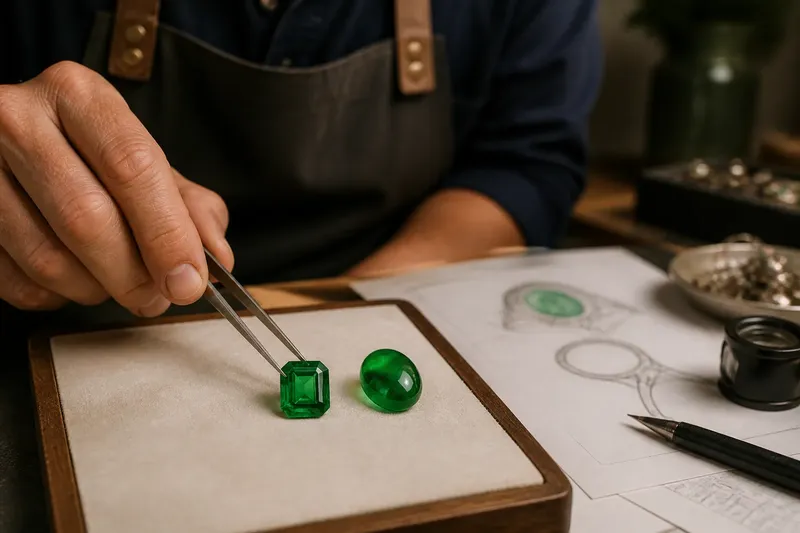
A qualified gemmologist considers several kinds of evidence together. Depending on the stone and the question, examination may include magnification, optical observations, specific gravity, a refractometer, a polariscope, a spectroscope or other laboratory methods. No single tool is a universal answer; the value lies in selecting appropriate tests and interpreting their results together.
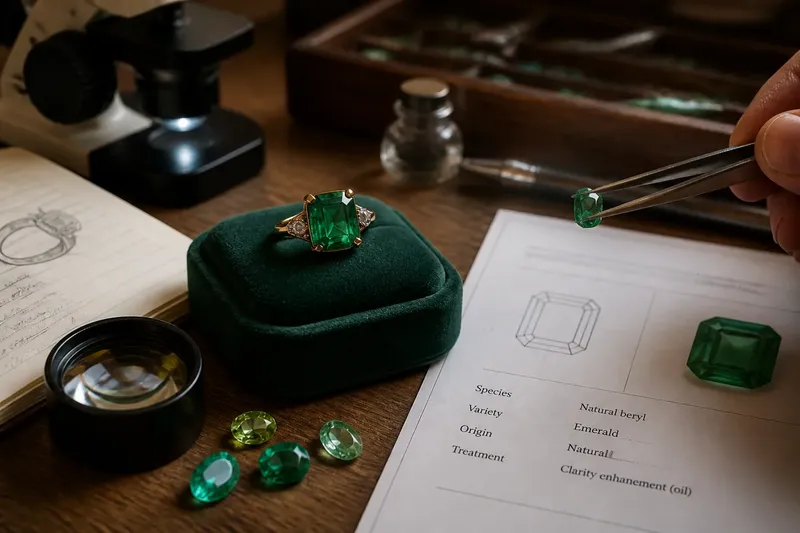
Testing may also address whether a stone is natural or laboratory-grown, and whether it has been treated. Emeralds are commonly treated to improve the apparent clarity of fractures, often using oils or other filling substances. Such treatment does not by itself make a stone “not an emerald”, but it can affect its description, care and commercial value.
Read a report for its precise wording. It may identify the material, state whether it is natural or synthetic, and describe detectable treatment. A sales label may use a shorter description, so ask whether a report accompanies the stone and whether its details correspond to the item being offered.
What should you ask before accepting the name?
For a modest piece bought as jewellery, a clear written description may be enough for your purpose. For a significant purchase, an inherited stone, or a piece that needs to be insured or resold, independent identification can be more useful than relying on a seller’s verbal assurance. The appropriate level of examination depends on the decision you need to make.
- Check whether the description says natural emerald, laboratory-grown emerald or another material; if it is vague, ask the seller to clarify it in writing before relying on the name.
- Check whether the description mentions clarity enhancement or other treatment; if it does, ask what is disclosed, and if it does not, ask whether treatment has been assessed.
- Check whether a gemmological report is available and names this particular stone; if it is, compare its details with the item, and if it is not, seek independent identification when the decision matters.
- Check whether the setting or mounting may limit examination; if it does, ask the gemmologist whether assessment is possible as set, and if not, discuss whether a jeweller can remove the stone safely.
- Check the return or review terms if identification differs from the description; if the terms are unclear, request written clarification before proceeding, and if the seller will not provide it, reconsider the purchase.
- Check whether the examiner’s qualifications and proposed assessment suit your purpose; if they do, ask for the findings in writing, and if they do not, seek a suitably qualified gemmologist or recognised laboratory.
Say you inherit a green ring with a handwritten note calling it an emerald. The starting information is just the ring and the note; neither establishes the material. You take the ring to a suitably qualified gemmologist and ask for the material, origin category and any detectable clarity treatment to be assessed. The examiner considers whether the setting limits inspection and, if needed, discusses safe removal with a jeweller. You receive a written report describing the findings, giving you a firmer basis for deciding how to catalogue, insure or care for the ring; if the setting prevents a firm assessment, the report can state that limitation rather than imply certainty.
What do readers ask about emerald identity?
Can a genuine emerald be pale or uneven in colour?
Yes. Emeralds vary in colour, and a stone need not match a familiar deep-green image to be an emerald. Colour can describe appearance, but it does not establish mineral identity.
Do inclusions prove that a stone is an emerald?
No. Inclusions are common in emeralds, but they also occur in other gemstones, and their appearance varies. An examiner considers them alongside other evidence.
Is a laboratory-grown emerald still an emerald?
It is emerald material grown in a laboratory rather than formed naturally. The distinction concerns origin, so a careful description should make that clear rather than leaving “emerald” to imply natural formation.
Can a jeweller identify an emerald by sight?
An experienced jeweller may recognise clues and know when further testing is needed, but unaided visual inspection does not always settle identity. For a consequential decision, ask about the examiner’s qualifications and whether a written gemmological report is appropriate.
What does colour tell you about an emerald?
Colour remains valuable: it helps you describe what attracts your eye, compare the visible character of stones and notice when a seller’s wording seems uncertain. It belongs at the beginning of identification, not at the end. When searching for an emerald, treat “green” as the first observation and the material description as a separate claim to verify.
That distinction leaves room to appreciate a stone without confusing appearance with identity. A green stone can be beautiful on its own terms, whether it is emerald, another gem or glass. Accurate naming does not diminish its colour; it lets you understand what the colour belongs to.