Faceted or Cabochon: Two Ways to Shape an Emerald
Compare faceted and cabochon emerald cuts by their geometry, outline and relationship to a setting, so you can judge which form suits a particular design.
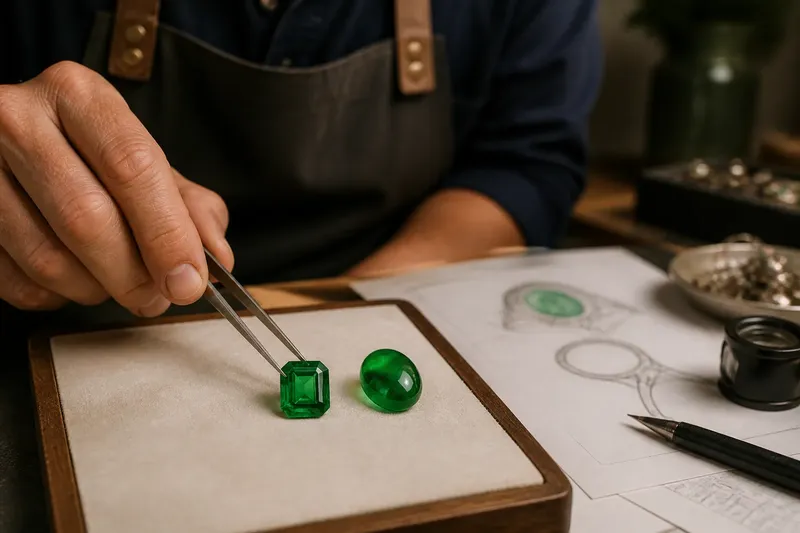
A jeweller places a rectangular emerald beside an oval, domed one, and the difference is plain before either reaches a ring: one is built from polished planes, the other from a continuous curve. Faceted or cabochon emerald cuts are choices about form, not grades of finish; each asks the cutter and setter to solve different design problems.
That distinction matters when a stone seems out of place. A cut can feel too intricate for its mount, or a rounded outline can sit awkwardly against angular metalwork. Rather than asking which form is better, look at how the stone’s geometry, natural features and setting work together.
What does a faceted cut contribute?
A faceted emerald is shaped into polished planes. Its outline might be rectangular, oval or round, while the familiar step cut uses broad, parallel rows of facets. Other facet arrangements create a different geometry, but in every case the surface is organised into distinct planes rather than one smooth dome.
Those planes give the design edges and visual structure. A step cut, for instance, can echo a straight-sided mount, while an oval faceted stone may soften the outline of a ring. The choice is not simply about adding sparkle: facet pattern and outline determine how the stone relates to the surrounding metal.
If the facet pattern feels too elaborate, inspect the whole design rather than blaming the cut alone. A detailed border or decorative shoulders can compete with the stone’s geometry. A plainer mount may give the facets a clearer role; if the stone still feels crowded, its outline may not suit that particular design.
What does a cabochon contribute?
A cabochon has a smooth, shaped top without polished facet planes. Its design depends on the relationship between the dome and its outline, often an oval or another rounded shape. This can make the stone feel sculptural, particularly when the mount follows its edge.
The dome also changes how the stone sits within a piece. A bezel—a rim of metal that surrounds the stone—can frame the curve, while a setting with angular details may create a deliberate contrast. If the outline is uneven, a closely fitted mount may emphasise that character; a more regular frame can instead give the design a composed edge.
There is no need to give a cabochon extra decoration just because it has no facets. If the dome and outline already make a clear shape, additional borders or motifs may distract from them. The useful question is whether the mount supports the form, not whether it fills every available space.
How do the stone and setting fit together?
Think of the cut and mount as parts of one design. A geometric step-cut emerald can sit naturally in an angular setting, while a bezel can trace a cabochon’s rounded edge. These pairings are useful starting points, not rules: a setter may use contrast intentionally, as long as the stone and mount remain visually legible together.
Look at the boundary between the two. Does the metal follow the stone’s outline, introduce a competing shape or partly cover an edge? A raised rim may frame a dome, but a broad one can make the visible outline feel cramped. A simple setting can give a complex cut room; an ornate setting can work when its details echo rather than obscure the stone’s form.
Say a maker has an oval emerald cabochon and a ring design with a sharp, rectangular border. The starting point is a rounded stone against a squared mount; the maker sketches a bezel that follows the oval, then sets that framed shape within the rectangle. The expected result is a clear contrast between the inner curve and outer geometry; if the oval appears swallowed by the border, the maker can simplify the frame or choose a mount that follows the stone more closely.
How should natural features shape the decision?
Emeralds can contain internal features visible within the stone. The cut does not automatically conceal them: a facet arrangement may make a feature appear differently from a smooth cabochon surface, but the effect depends on the individual gem and its shape. Consider whether a feature draws attention away from the outline or disrupts the design you want.
A cutter also has to work with the rough stone’s existing form and character. Its shape may lend itself to broad facets or a rounded dome, and the amount of material available limits possible outlines. Choosing a cut is therefore a design decision with practical constraints, not a universal way to hide a mark or improve every stone.
If a proposed recut or setting change depends on the stone’s condition, ask an experienced gem cutter or jeweller to assess it. Recutting removes material and can alter the outline and the way internal features appear, so the likely design trade-offs should be explained before work begins.
How can you compare faceted and cabochon emeralds?
- Check the outline: If the stone’s shape reads clearly from above, compare it with the mount; if metal or decorative details interrupt it, consider a simpler frame.
- Check the facet pattern: If the planes give the design a clear structure, keep the surrounding shapes restrained; if they make the composition feel crowded, look at a plainer setting or another outline.
- Check the dome: If the curve is easy to distinguish from its edge, choose a mount that frames it; if the dome seems visually lost, consider a setting that gives the outline more definition.
- Check the boundary with the metal: If the mount follows the stone without hiding its edge, retain that fit; if it obscures the outline, ask about a narrower or differently shaped frame.
- Check the internal features: If a visible feature interrupts the shape you want to emphasise, ask a jeweller or cutter whether another orientation or design is suitable; if it remains part of the stone’s character, choose a setting that does not draw extra attention to it.
- Check the design’s main emphasis: If the piece is meant to foreground a geometric outline, consider facets; if it is meant to centre a continuous rounded form, consider a cabochon.
These checks do not produce a universal winner. They help identify the specific design choice to discuss with a jeweller: outline, cut, mount or the relationship between them.
Which questions help settle the comparison?
Does a faceted emerald always suit a formal setting?
No. Facets create a structured surface, but the overall character depends on the stone’s outline and the mount. A simple or rounded setting can make a faceted emerald feel less strict.
Is a cabochon an unfinished faceted stone?
No. A cabochon is deliberately shaped with a smooth top rather than polished facet planes. Its outline and dome are central parts of the finished design.
Can any emerald be cut as a cabochon or into facets?
No single cut suits every rough stone. Its existing shape and internal character limit the options, so a cutter should assess the individual gem before recommending a form.
Can a faceted emerald be recut as a cabochon?
It may be possible, but recutting removes material and changes the stone’s shape. Ask an experienced gem cutter to assess the likely design trade-offs before deciding.
What is not worth the effort?
It is not useful to treat “faceted” and “cabochon” as shorthand for formal and informal, or skilled and unskilled. Those words describe how a stone’s surface has been shaped; they do not settle whether it belongs in a particular piece.
When comparing faceted or cabochon emerald cuts, focus on the specific relationship between the stone’s outline, surface and setting. A clear design choice—whether to frame straight edges or follow a smooth curve—often matters more than making the gem fit a general rule.